The field visit is not a ceremonial confirmation of a software result. It is another stage of the investigation, capable of supporting, changing or rejecting the working explanation. A crew may find a leaking fitting, an unrelated noise source, an inaccurate asset record or no decisive evidence. Each can be a useful result when it is documented clearly and returned to the people interpreting the measurements.
Give the crew a question they can test
A useful handover includes the asset reference, current location information, relevant traces, operating conditions and checks already completed. State why this location was selected and how broad the uncertainty remains. An acoustic estimate based on uncertain pipe length should not be handed over as a confirmed excavation point. Include access constraints and a contact for operational questions.
Confirm that the responsible organisation has approved the work and assessed the site. Traffic, lifting, electrical equipment, contaminated surfaces and confined spaces can create serious hazards. The Health and Safety Executive provides guidance on these subjects in Great Britain. A web guide cannot determine whether a chamber is safe to open or enter. Members of the public should not operate valves, remove covers or investigate utility equipment themselves.
Confirm identity before interpreting a reading
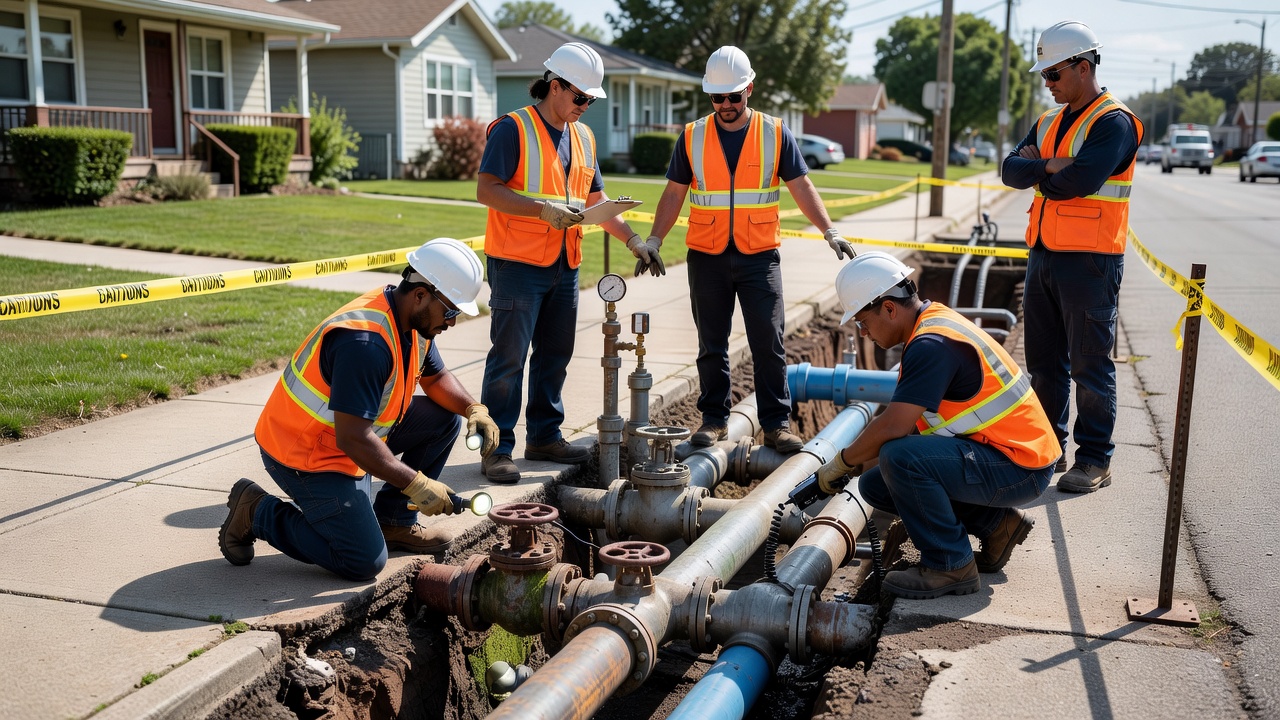
On arrival, verify that the physical asset matches the record. Fittings can be mislabelled, maps can be outdated and nearby services can be confused. Record the actual location, visible configuration and relevant changes. Surface water may have travelled from elsewhere, while a buried leak may show no obvious surface sign. Visual evidence is helpful, but neither wet ground nor dry ground settles the diagnosis.
Authorised specialists may use listening devices, correlation, pressure checks or other approved techniques to narrow the suspected area. Their choice should reflect pipe material, access, operating state and the evidence already available. Repeating a measurement under quieter conditions can help distinguish persistent leakage-like sound from intermittent activity. Any operational change must follow the utility’s procedures and consider service and water-quality consequences.
Keep measurements traceable. Note the equipment used, relevant configuration, time, contact point and conditions. If a result conflicts with the remote record, do not simply choose the one that looks more convincing. Check time alignment, hydraulic connections and whether the field test examined the same condition. A pressure check made after a valve change may be valid but not directly comparable with the original event.
Separate locating, exposing and repairing
Evidence may justify another survey without justifying excavation. Conversely, an urgent condition may require escalation before a precise location is available. The responsible utility must balance safety, service continuity, asset consequence and evidence strength. Excavation requires its own planning, service searches and controls. HSE publication HSG47 addresses avoiding danger from underground services; it is not replaced by a map pin or sensor estimate.
If work exposes a defect, record what was actually found: component, material, condition, failure location and repair performed. Avoid attributing a root cause from appearance alone when engineering assessment is needed. Corrosion, ground movement, installation defects and operating stress may require different follow-up. A repaired leak is an opportunity to improve asset knowledge, not merely clear an alarm.
If no defect is found, preserve that result with the search scope and limitations. “No leak confirmed at the inspected fittings” is more informative than “false alarm” when a wider pipe section remains untested. Assign a next review where appropriate. An unresolved event should not stay indefinitely on a dashboard without an owner or a documented decision to close it.
Check what changed after the intervention
Post-repair monitoring should use comparable conditions. Flow may not immediately return to an old baseline if demand or pressure changed during the work. Acoustic noise may fall while another source remains. Check that instruments were reconnected correctly and that operational settings returned to their authorised state. Restoration, disinfection, sampling and commissioning requirements belong to the utility’s procedures and applicable drinking-water rules.
Feed the outcome back into the monitoring programme. Did the alert provide a useful lead? Was the estimated area realistic? Did communications delay the response? Were maintenance costs higher than expected? These questions improve placement, thresholds and staff handover. Guidance from the American Water Works Association and Water Research Foundation can provide broader distribution-system context, but local requirements remain decisive.
A compact verification record
- ObservationPreserve the original signal, source and time window.
- ContextRecord operations, customer effects and data-quality checks.
- Field evidenceDescribe equipment, locations, conditions and limitations.
- DecisionName the next action, responsible owner and review need.
- OutcomeLink confirmed findings and post-work measurements to the original event.
Residents can contribute useful observations without entering the work area. Report visible leakage or service concerns through the local water supplier’s official channels, giving the location and time. For immediate danger, use the appropriate emergency route. Jumbipuremelody is an independent information website and does not receive utility incident reports or dispatch crews.
Safety and technical context
- HSE: HSG47 — avoiding danger from underground services.
- HSE: confined spaces — legal and safety context.
- American Water Works Association — water-system technical resources.
- Water Research Foundation — water-sector research.